New Ideas from Dead Economists by Todd G. Buchholz
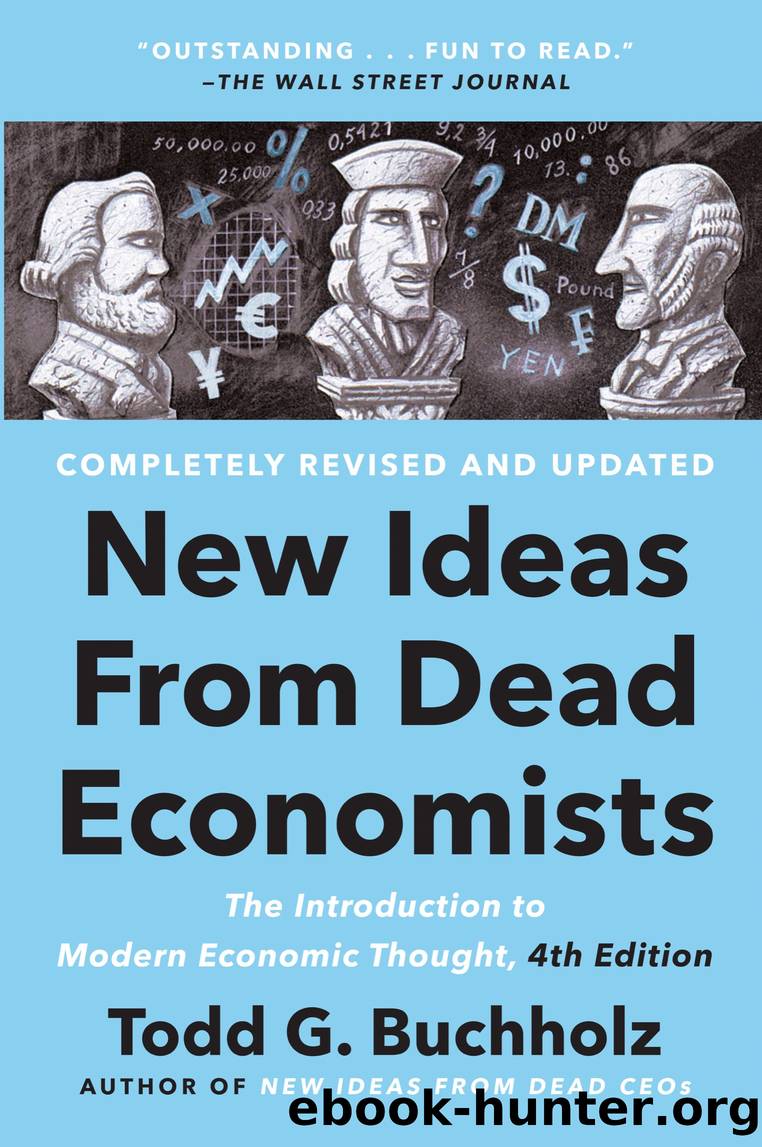
Author:Todd G. Buchholz [Buchholz, Todd G.]
Language: eng
Format: epub
Publisher: Penguin Publishing Group
Published: 2021-01-26T00:00:00+00:00
Only Marx wrote a more glowing paean to capitalism.
But Marshall was no knave. He knew work had to be done. He begged his students to help make economics a tool for enhancing manâs well-being. He was disgusted by the remaining poverty he saw, but he refused to let disgust guide his economic logic. Nature would make no quick leaps in wiping out destitution.
Marshall retired in 1908 but continued to refine and update his works. He retreated to his house on Madingley Road in Cambridge, where he endured an assortment of ailments, digestive and respiratory. He lived until 1924, a few weeks shy of his eighty-second birthday, remaining the grand old professor of Cambridge. He left his estate to Mary (who would live until 1944) and asked that she provide an annual lifelong gift to their gardener and maid, along with a generous grant to Newnham College, where he had established himself as one of the first Cambridge dons to educate women. He provided scholarships for economics students, specifying that one-quarter should go to Newnham women, and established the Marshall Library to support the economics faculty. Mary spent the next twenty years painting watercolor landscapes and pedaling her bicycle to the library to work as a volunteer librarian, until she retired at age eighty-seven. Visitors to the library today can see Alfredâs patron saint, the portrait of the workingman that he bought at the little shop for a few shillings 150 years before.
While researching the first edition of this book, I decided to pedal my bicycle to the old Marshall house on Madingley Road. I wasnât sure what I would find roughly a half century after Maryâs death. I knocked at the door, and a stern-looking older woman answered. If I hadnât known that the Marshalls were childless, I would have guessed that she was Maryâs now-elderly daughter. I explained my mission, that I was writing a book on Marshall. The old lady paused, suddenly grinned, and then invited me into the parlor. It was in this room that Marshall would give students a copy of his Principles and inscribe it, âTo ____, in the hopes that in due course he will render this treatise obsolete.â Then we strolled out to the backyard, and the lady said, âThe professor loved living along the fen. He thought the marshes would help his breathing. Alfred and Mary loved the garden and the students. They tended the garden and they tended the students together.â
Keynes praises Marshall for a rare combination of gifts. The master economist must, like Marshall, be a mathematician, historian, statesman, and philosopher to some degree. âHe must study the present in the light of the past for the purposes of the future.â40
A man who shared Karl Marxâs surname but had a better sense of humor was once scolded: âSir, you try my patience.â Groucho responded: âI donât mind if I do. You must come over and try mine sometime.â
All economists would do well to âtryâ Marshallâs brand of patience. He did not wait for answers, he searched for them.
Download
This site does not store any files on its server. We only index and link to content provided by other sites. Please contact the content providers to delete copyright contents if any and email us, we'll remove relevant links or contents immediately.
Life 3.0: Being Human in the Age of Artificial Intelligence by Tegmark Max(5558)
The Sports Rules Book by Human Kinetics(4386)
The Age of Surveillance Capitalism by Shoshana Zuboff(4292)
ACT Math For Dummies by Zegarelli Mark(4047)
Unlabel: Selling You Without Selling Out by Marc Ecko(3662)
Blood, Sweat, and Pixels by Jason Schreier(3624)
Hidden Persuasion: 33 psychological influence techniques in advertising by Marc Andrews & Matthijs van Leeuwen & Rick van Baaren(3565)
The Pixar Touch by David A. Price(3438)
Bad Pharma by Ben Goldacre(3427)
Urban Outlaw by Magnus Walker(3395)
Project Animal Farm: An Accidental Journey into the Secret World of Farming and the Truth About Our Food by Sonia Faruqi(3221)
Kitchen confidential by Anthony Bourdain(3089)
Brotopia by Emily Chang(3053)
Slugfest by Reed Tucker(3002)
The Content Trap by Bharat Anand(2924)
The Airbnb Story by Leigh Gallagher(2854)
Coffee for One by KJ Fallon(2636)
Smuggler's Cove: Exotic Cocktails, Rum, and the Cult of Tiki by Martin Cate & Rebecca Cate(2540)
Beer is proof God loves us by Charles W. Bamforth(2461)
